
How can AI help?
Bridge of the Slovak National Uprising
–
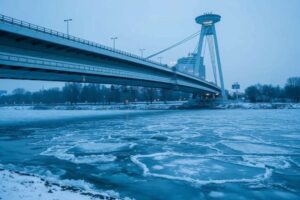

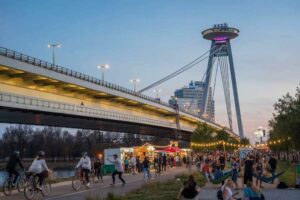
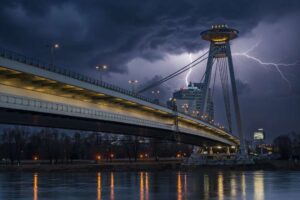
The SNP Bridge (Bridge of the Slovak National Uprising) was built between 1967 and 1972 and quickly became one of Bratislava’s most recognizable landmarks. At the time of its construction, it was considered a technical marvel thanks to its unique design – a single pylon supporting a suspended bridge deck without any supporting pillars in the middle of the Danube.
Its construction dramatically changed the cityscape, as much of the old Podhradie neighborhood had to be demolished, including Bratislava’s historic synagogue. This decision remains one of the most debated moments in the city’s urban history.
Despite the controversy, the bridge became an essential artery connecting the old city center with the rapidly growing district of Petržalka and an iconic part of Bratislava’s silhouette.
The bridge is instantly recognizable thanks to the UFO-shaped restaurant and observation deck perched 95 meters above the river. From the top, visitors enjoy a breathtaking 360° panoramic view of the entire city, the Danube, and the surrounding landscape – on a clear day, even the Austrian Alps.
Visiting the UFO is a unique experience both during the day and at night. At sunset, the city glows in golden light, and after dark, Bratislava turns into a sparkling sea of lights.
This feature elevates the SNP Bridge from a simple piece of infrastructure into a world-class tourist attraction that offers one of the best perspectives of the city.
Before the SNP Bridge was built, Petržalka was connected to the rest of Bratislava only by the old Starý most. Crossing the river was slower and less convenient, which limited the development of the southern bank.
The opening of the new bridge completely transformed city life, making it possible for tens of thousands of people to commute daily and for Petržalka to grow into the largest residential district in Slovakia.
Today, the bridge is not just for cars – it has a pedestrian walkway with stunning views, allowing locals and tourists to experience the river and the skyline in a safe and pleasant way.
The SNP Bridge is one of the few asymmetrical suspension bridges in the world, with its entire deck hanging from a single steel pylon. The solution was highly ambitious and required exceptional engineering precision.
The main advantage of this design is the absence of pillars in the river, which allows unhindered boat traffic on the Danube – an important factor for Bratislava as a port city.
Architecture and engineering enthusiasts often come here to admire its elegant silhouette, which has stood the test of time for more than 50 years.
After sunset, the SNP Bridge transforms into a glowing line above the river. Its lights reflect beautifully on the water, and the UFO turns into a shining beacon visible from across the city.
An evening walk along the pedestrian path is quiet and atmospheric. You can stop in the middle of the bridge, watch the boats pass by underneath, and enjoy the illuminated view of Bratislava Castle and the historic center.
For couples and photographers alike, this is one of the most romantic spots in the city.
For Bratislava residents, the SNP Bridge is more than a tourist sight – it is part of their daily routine. It carries thousands of cars, buses, cyclists, and pedestrians every single day.
The pedestrian path is popular with joggers and commuters who enjoy the morning sunrise or evening sunset over the Danube as part of their daily journey.
In this way, the bridge is not just infrastructure but a living artery of the city, keeping Bratislava connected and moving.
The bridge has become one of the city’s strongest visual symbols. Its shape is instantly recognizable and often featured on postcards, posters, and promotional materials.
It is also a popular backdrop for music videos, movies, and photo sessions – a perfect setting that combines futuristic architecture with the historic charm of the old town nearby.
This cultural significance makes the SNP Bridge an integral part of Bratislava’s identity, beloved by locals and visitors alike.
Standing on the bridge, you can feel the power of the Danube flowing below. You can see cargo ships, tourist boats, and the ever-changing river currents, giving you a sense of connection to Europe’s great waterway.
The bridge also provides direct access to the riverside promenade and the cycling path leading all the way to Austria. This makes it a natural gateway to active recreation and outdoor adventures.
Few places in Bratislava offer such a direct encounter with the river and its dynamic presence.
The SNP Bridge is closely tied to the story of the Podhradie neighborhood, much of which was demolished to make way for the project. The old streets and synagogue are gone, but their memory is preserved in photos, exhibitions, and memorial plaques.
Walking near the bridge can be a journey into the past, imagining how the area once looked and how dramatically the city changed in the 20th century.
This duality – progress and loss – gives the SNP Bridge a special place in Bratislava’s collective memory.
Together with Bratislava Castle, the SNP Bridge forms one of the most photographed silhouettes of the city. Whether you see it from the riverbank, from a boat, or from the castle hill, its shape is unmistakable.
The view from the UFO observation deck offers a spectacular perspective of both the old and modern parts of Bratislava, its bridges, and the distant hills.
For many visitors, this is the moment when they truly feel they have seen Bratislava from every angle – a memory that stays with them long after they leave.
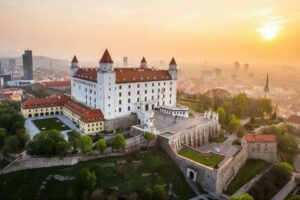
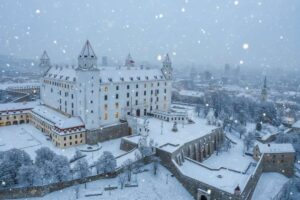
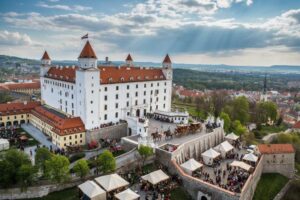
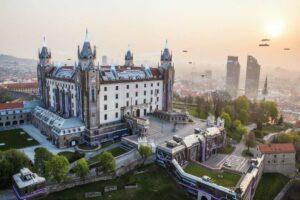
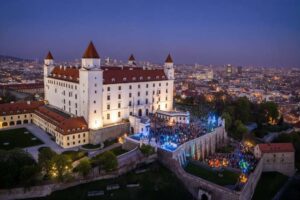
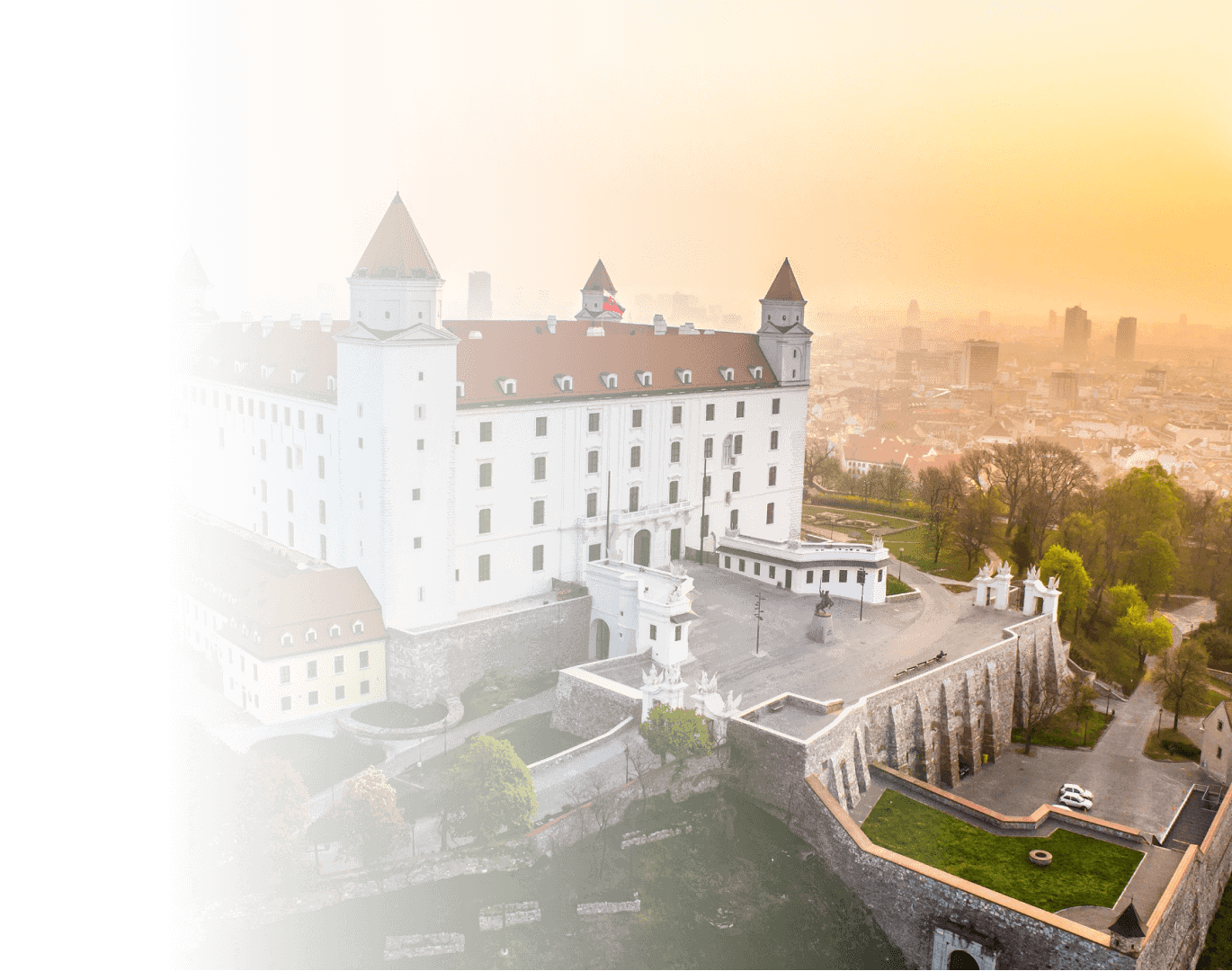
Bratislava Castle is one of the most iconic landmarks of the Slovak capital. Its four corner towers give it a distinctive shape that locals often call the “upside-down table.” The hill on which it stands has been inhabited since prehistoric times, with traces of settlements dating back to the Bronze Age.
Throughout history, the castle served as a royal residence, a military fortress, and a strategic stronghold overlooking the Danube. Its golden era came under Maria Theresa in the 18th century, when the castle was transformed into a magnificent Baroque palace with grand halls and gardens.
After a devastating fire in 1811, the castle remained in ruins for nearly 150 years until a major reconstruction in the 1950s and 60s restored its former glory. Today, it stands proudly as one of Slovakia’s most visited historical monuments.
Bratislava Castle was the site of many key moments in Central European history. It hosted coronations of Hungarian kings and queens, parliamentary sessions, and important diplomatic negotiations. Its halls witnessed decisions that shaped the region for centuries.
Today, the castle serves as the seat of the Slovak National Council and houses part of the Slovak National Museum. Visitors can explore exhibitions on Slovak history, archaeology, and fine art.
From the castle courtyards, you can enjoy one of the best views of the Danube, the old town, and the modern skyline of Bratislava.
The present appearance of Bratislava Castle is the result of a large-scale Baroque reconstruction in the 18th century. Its symmetrical design with four towers creates a harmonious impression and makes it a perfect centerpiece of the city’s panorama.
Inside, the castle contains ceremonial halls used for state receptions, exhibitions, and cultural events. The interiors are elegantly restored, highlighting the richness of Baroque architecture.
The castle gardens have been redesigned according to historical plans and now provide a peaceful retreat where visitors can stroll and relax while enjoying stunning views of the city.
The castle hill is one of the richest archaeological sites in Slovakia. Excavations have uncovered Celtic oppidum remains, Great Moravian rotundas, and medieval fortifications, proving the hill’s strategic importance throughout history.
Every new discovery sheds light on how people lived here over the centuries, making the castle a living museum of Slovak and European heritage.
For visitors, exploring the exhibitions and archaeological displays offers a journey through time – from prehistory to the modern era – in a single location.
Bratislava Castle, together with the SNP Bridge, creates the city’s most iconic skyline. It is visible from afar and serves as a natural landmark for travelers approaching Bratislava by road or river.
At night, the castle is beautifully illuminated, standing as a glowing white crown over the city. The sight is particularly striking when viewed from the opposite bank of the Danube.
A photograph of the castle is almost a mandatory souvenir for every visitor to Bratislava.
The castle grounds are open to the public and are one of the most popular spots for walks in Bratislava. Locals and tourists alike come here to enjoy the peaceful courtyards and breathtaking views over the Danube and the old town.
On weekends, the castle is full of life – families with children, runners, and travelers explore the grounds, take photos, and rest in the gardens.
The Baroque terraces and walkways provide a calm and scenic escape just minutes from the bustling city center.
After centuries of decay and neglect, Bratislava Castle underwent an extensive reconstruction in the 20th century. The goal was to return it to its Baroque appearance while adapting it for modern use.
In recent years, additional renovations have been carried out, including the reconstruction of the fortification walls, the gardens, and interior spaces for exhibitions.
Thanks to these efforts, the castle is once again a proud representative of Slovak culture and history, ready to serve future generations.
The castle is not just a historical monument but also a lively cultural hub. It regularly hosts concerts, theater performances, exhibitions, and festivals, attracting visitors of all ages.
Summer evenings are especially magical when open-air events take place in the courtyards or on the terraces overlooking the city.
This fusion of history and culture makes the castle an active part of Bratislava’s present, not just its past.
Like every castle, Bratislava Castle has its share of legends and mysterious stories. Tales of hidden treasures, secret tunnels, and ghostly apparitions have been passed down through generations.
These legends add an element of mystery and excitement to every visit. Children in particular love hearing the stories of knights, kings, and mythical guardians of the castle hill.
Such narratives turn the castle from a static monument into a place where imagination can roam free.
The hilltop location of Bratislava Castle offers one of the most spectacular vantage points in the city. From here, you can see the Danube, the SNP Bridge, the historic old town, and even as far as the Austrian and Hungarian lowlands on clear days.
The view is impressive in every season – whether framed by autumn colors, winter snow, or the greenery of summer.
For many visitors, this view is the highlight of their stay in Bratislava, a moment to pause and take in the unique character of the Slovak capital.
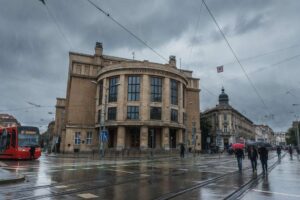
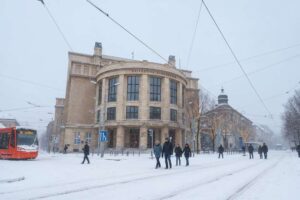
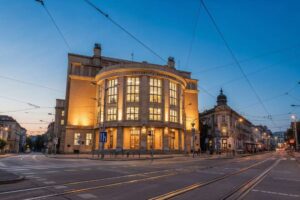
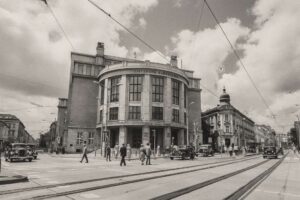
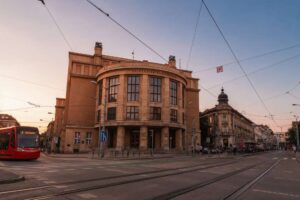
The Rectorate of Comenius University is one of the most important functionalist buildings in Bratislava. It was built between 1931 and 1932, designed by renowned architects Friedrich Weinwurm and Ignác Vécsei, who brought a modern, clean, and purposeful style to the city. Its semicircular façade with a columned portico has become a landmark of Šafárik Square and still feels both representative and timeless.
From the very beginning, the building was intended to serve as the administrative and ceremonial center of the university. Over the decades, it has hosted matriculation ceremonies, graduations, academic conferences, and senate meetings. Its grand Aula UK is where students receive their diplomas and where honorary doctorates are conferred upon outstanding figures from the world of science and culture.
Today, the Rectorate is not only a symbol of academic life but also an architectural icon of Bratislava. It continues to attract architects, historians, and tourists, representing one of the most beautiful examples of modernist architecture in Slovakia.
The Rectorate is where decisions are made that affect tens of thousands of students and hundreds of professors. Each year, it hosts official ceremonies such as matriculations, rector inaugurations, and receptions of international delegations. Its atmosphere is formal yet inspiring – everyone who enters feels they are stepping into a place where history and knowledge meet.
Inside, you will find ceremonial halls, offices, and meeting rooms, including the main Aula, which is the venue for the university’s most significant events. This is where academics, researchers, and students gather to discuss the future of education and science.
For many students, their first steps into the Rectorate are symbolic – it marks the beginning of their journey through university life and gives them the sense of belonging to a larger community that shapes society.
The Rectorate stands in the heart of Šafárik Square – a lively intersection of student and city life. Thousands of people pass through here every day, heading to lectures, crossing the bridge toward Petržalka, or continuing to the city center. The building is not isolated but fully integrated into the pulse of Bratislava.
The space in front of the Rectorate often becomes a stage for public gatherings, student protests, or cultural events. In the past, this was the site of important demonstrations and discussions that influenced Slovak society.
This gives the Rectorate a unique “genius loci.” It is a place where history blends with the present – where the energy of academic life meets the rhythm of the city.
The Rectorate’s façade is a feast for anyone who appreciates architecture. Its monumental semicircular windows, columned portico, and clean lines make it a textbook example of functionalist design. Every detail is carefully considered to create harmony and dignity.
Inside, you will find a beautiful Aula, wide staircases, and spaces that balance historical value with practical use. The Aula hosts graduations, academic lectures, and public events that open the university to the wider community.
The building is listed as a national cultural monument, underlining its importance for Slovak architectural and academic heritage.
Throughout its history, the Rectorate has witnessed many key moments. During the Velvet Revolution in 1989, it was here that student leaders gathered to organize general strikes and help steer the country toward democracy.
At those times, the Rectorate was more than an administrative center – it became a space for dialogue, solidarity, and courage. The spirit of open discussion lives on today, as the university continues to support critical thinking and free debate.
For visitors, the Rectorate is thus not just a place of education, but a symbol of civic engagement and the desire for freedom.
Comenius University is the largest and oldest university in Slovakia, bringing together 13 faculties and educating more than 20,000 students each year. The Rectorate is where all these faculties meet administratively, coordinating research, teaching, and development.
Decisions made here affect admissions, research funding, and international partnerships. It is, in many ways, the “control center” of Slovak higher education and science.
This makes the Rectorate not just an administrative building, but a place that shapes the future of thousands of young people every single year.
The Rectorate sits at the meeting point of Bratislava’s historic center and its more modern districts. From its front steps, you can see Šafárik Square, the Apollo Bridge, and the Danube.
Its iconic steps have become a favorite location for graduation photos, wedding portraits, and public gatherings. For many, it is the backdrop to some of their most important life moments.
In this way, the Rectorate is part of the city’s daily life, not just a place students pass through – it is tied to personal memories and collective history alike.
Although it represents tradition, the Rectorate is also where innovation takes place. Comenius University supports start-ups, research incubators, and collaboration with the private sector.
Within its walls, strategies are developed that help young scientists and entrepreneurs find opportunities both in Slovakia and abroad.
For students, it is inspiring to know that this is where decisions are made about grants, projects, and exchanges that could shape their future careers.
Each year, the Rectorate welcomes hundreds of international students, researchers, and guests. It serves as the gateway for Erasmus+ exchanges and other global partnerships.
The atmosphere inside is cosmopolitan – many languages are heard in the hallways, and ideas are exchanged across cultures. This makes Comenius University one of the most open and outward-looking academic institutions in the region.
Thanks to this, Bratislava is becoming a more international city, and the Rectorate is one of the places where this diversity is most visible.
For many students, the Rectorate is the symbolic starting point of their university story. Their first visit here is often for matriculation, marking the beginning of a new life chapter.
Throughout their studies, they return here for lectures, events, and finally their graduation ceremony. The steps of the Rectorate thus become a place where one chapter ends, and another begins.
This makes the building special to countless alumni – a place full of memories, friendships, and achievements that last long after they leave the university.
A series of high-level, ministerial, expert, and thematic events will be hosted by Slovakia during the last week of November 2025.
The BratislavAI Forum will offer a unique platform to address the most pressing human challenges emerging from the rapid development of artificial intelligence. A key focus will be on defining the balance between technological progress and the cultivation of essential human capabilities, ensuring that technology serves humanity and meets inclusivity.